Orders and shipping
When a buyer places an order, the clock starts. This guide covers how an order moves from placed to delivered, and how shipping works.
How you hear about a new order
New orders show up on your dashboard under Needs attention, and you get a notification in the portal. Check in daily. The faster you accept and pack, the better your buyer's experience and your store's standing.
Two ways to ship
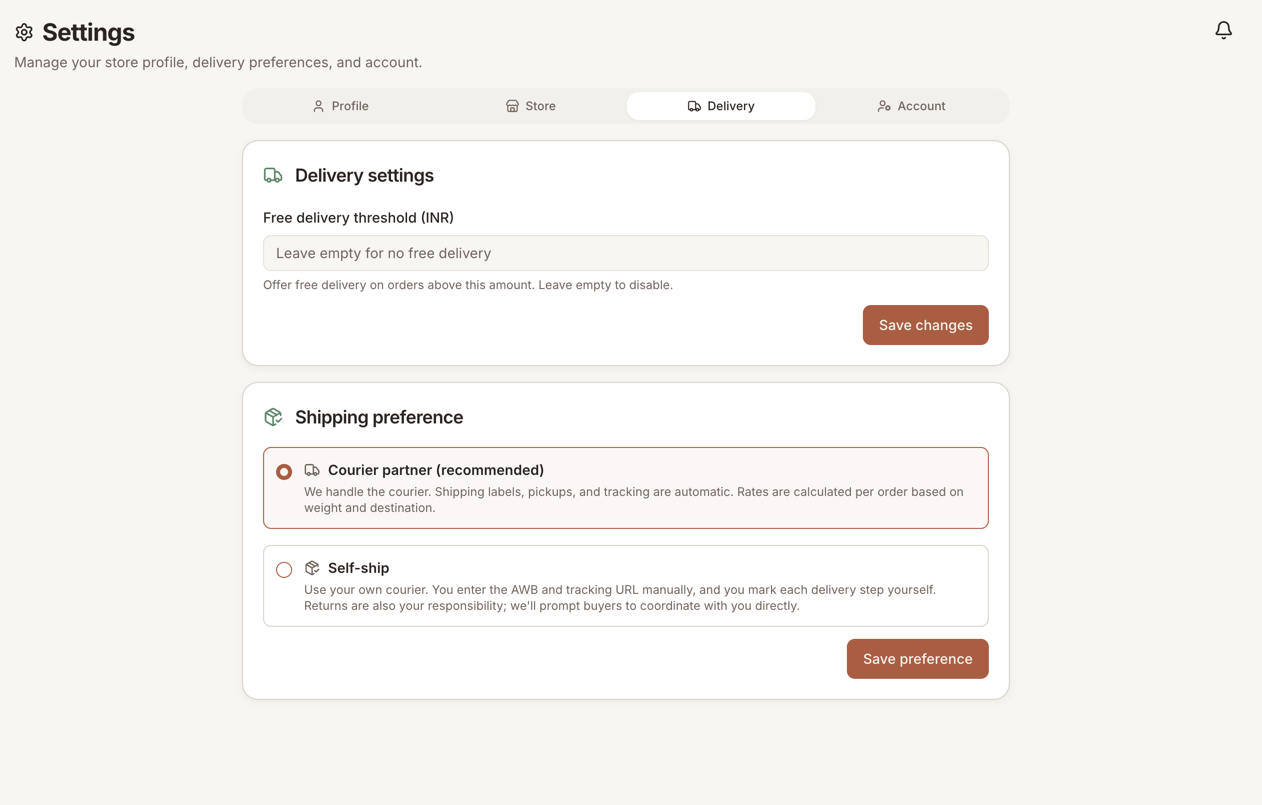
You pick one in your settings, and it applies to your orders.
- Courier managed (Delhivery). Our courier partner picks up from your address, tracks the parcel, and delivers it. You pack it and hand it over. This is the default and the least work.
- Self ship. You arrange your own courier and enter the tracking details yourself. You also move the order through transit and delivery by hand. Choose this only if you already have a shipping setup you trust.
You choose your default in Settings. Each order remembers which method applied when it was placed, so changing your setting later does not disturb orders already in flight.
The order flow
An order moves through these stages:
Placed → Accepted → Packed → Pickup scheduled → In transit → Out for delivery → Delivered
Here is what you do at each point.
- Placed. A new order is waiting for you. Accept it to confirm you can fulfil it. New orders show up in your dashboard alerts so you do not miss them.
- Accepted. You have confirmed the order. Now pack it.
- Packed. Mark it packed once it is ready to go. For courier-managed orders, this is when a shipping label is generated. Print the label and stick it on the parcel.
- Pickup scheduled. The courier is set to collect it. Hand over the packed parcel.
- In transit and out for delivery. The parcel is on its way. For courier-managed orders, tracking updates on its own. For self-ship orders, you update these stages yourself.
- Delivered. The buyer has it. This is the point your earnings start counting toward payout.
Packing well
Good packing prevents damage claims and returns:
- Wrap fragile items so nothing moves inside the box.
- Use a box or mailer that fits, and match what you enter as the product weight.
- Stick the shipping label flat and fully visible.
- If you sell food, follow FSSAI packing and labelling rules, including any use-by date.
Pending pickups
If you have several orders packed and waiting for the courier, the Pending pickups page lets you handle them together instead of one at a time. Your dashboard flags packed orders that still need a pickup scheduled.
If a label fails
Once in a while a shipping label does not generate on the first try. When that happens, the order is flagged in your dashboard so you can retry it. It is usually a temporary courier issue and clears on a second attempt. If it keeps failing, write to support.
Cancelling an order
You can cancel an order before it ships if you genuinely cannot fulfil it, for example the item is out of stock. The buyer is refunded in full. Cancel only when you have to. Frequent cancellations are a poor experience for buyers and reflect on your store, so keep your stock counts accurate to avoid them.
Returns
The default is that products are not returnable. Where a return is allowed, the buyer has a short window, up to 4 days from delivery, to request one. When a return comes in:
- You review and approve it.
- For courier-managed orders, a reverse pickup is arranged automatically. A flat ₹80 reverse-shipping fee is deducted from your payout, because the seller covers return shipping.
- For self-ship orders, you coordinate the return with the buyer directly, so there is no reverse-shipping deduction from us.
- Once the product is back with you, the buyer is refunded the full amount including their original shipping, and the commission on that order is reversed. You are not left paying commission on a sale that came back.
When a delivery comes back (RTO)
Sometimes a parcel cannot be delivered, for example the buyer is unreachable or refuses it, and it returns to you. This is called an RTO. The buyer is refunded and the commission is reversed, the same as a return. You are not charged the ₹80 reverse-shipping fee on an RTO.
If a parcel is damaged in transit
If a courier-managed parcel is damaged on the way and the buyer reports it with photos soon after delivery, raise it with support. Where the order qualifies for shipment protection and the damage is found to be a transit fault rather than a packing fault, the platform makes you whole for that order rather than leaving you to absorb it. Pack well, because packing faults are not covered.
Manual orders
If you sell to someone off the platform, a phone order or a walk-in, you can record it as a manual order for your own books. Manual orders skip the courier entirely. They have no shipping, no tracking, and no buyer notifications, and they move straight from placed to delivered, or to cancelled. Use them to keep all your sales in one place.
Next
For how and when the money reaches you, see payments, settlements, and fees.